





E Invoicing for Real Estate | Electronic Invoicing Dubai, UAE
United Arab Emirates info@sscoglobal.com

E Invoicing in UAE for the Real Estate

Let’s explore what this transformation holds for your business.

E Invoicing in UAE for the Real Estate Sector

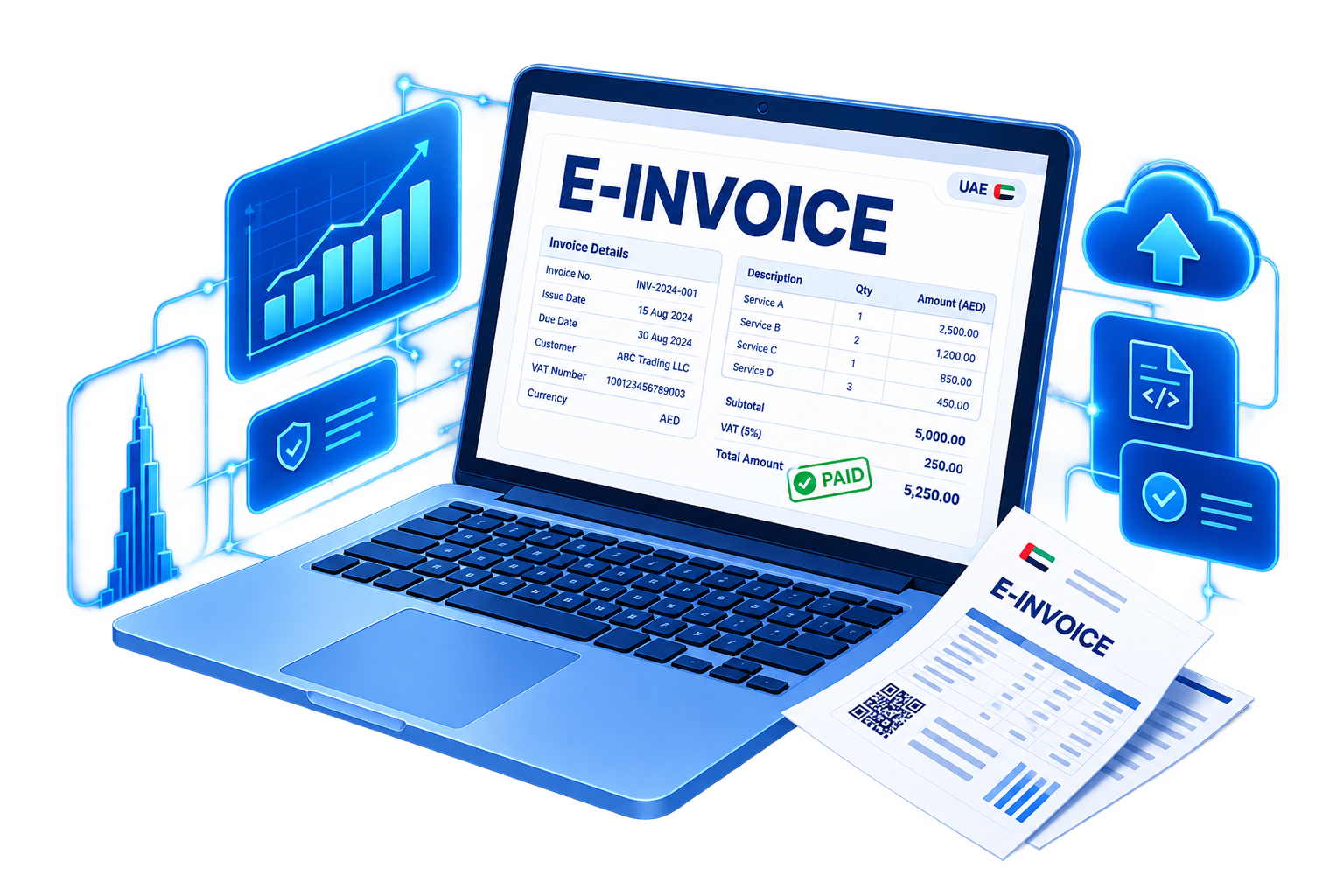
A real estate invoice may record a property sale, a rental payment, a brokerage commission, a management fee or a recovery made on behalf of an owner. Each transaction begins with different commercial facts, yet the information must eventually reach the accounting and tax records in a consistent form. E-Invoicing in UAE for the Real Estate Sector will make that connection more direct by exchanging structured invoice data through the national electronic invoicing system.

Happy Customers
0 +
Skilled Accountants
0 +
Global Offices
0 0
Tailored Solutions
0 +

Preparation requires developers, agencies and property managers to review how invoice information is created, approved, recorded and transmitted. The business must identify who is supplying what, confirm the VAT treatment, collect accurate customer details and connect its billing process with an Accredited Service Provider.

SS & Co. Global helps real estate businesses examine these areas and prepare an implementation plan around their actual transaction flows.

What Is E-Invoicing for Real Estate Businesses?

An electronic invoice is a structured set of invoice data issued by a supplier, exchanged electronically with a buyer and reported to the Federal Tax Authority. A PDF, Word document, scanned invoice, image or ordinary email attachment does not qualify as an e-invoice because it is not structured for automatic system processing.

FTA Compliant Solutions

End-to-End Support

Seamless Integration

Secure & Reliable

E Invoicing For Real Estate UAE

Property businesses need to understand this difference when preparing their invoicing systems. Many real estate businesses already generate invoices through an ERP, property management platform or accounting system and send a PDF to the customer. Under the new framework, the underlying data must be created in the required format and transmitted through the approved network. A readable copy may still be useful for the customer, but the structured record becomes the document exchanged and reported through the system.

E-Invoicing for Real Estate can cover several commercial documents, including invoices for commercial property sales, rent, brokerage commissions, development management, facilities services and other taxable business transactions. Electronic credit notes will also be required where an earlier invoice needs to be reduced or cancelled.

The system does not determine whether a unit is residential or commercial, whether a payment is a deposit or consideration, or whether an agency acts as principal or intermediary. The business must establish these facts before generating the invoice data.

Why Is E-Invoicing Important for UAE Real Estate Companies?

Real estate businesses often manage high-value transactions involving several parties, long contracts and staged payments. Information may pass between sales teams, leasing departments, property managers, finance staff and external brokers before an invoice is issued. E-invoicing introduces a common data structure and validation process across that chain.

Structured fields create a consistent record of the supplier, buyer, amount, VAT treatment and document references. They make it easier to connect an invoice with the unit, contract, payment plan or commission agreement that produced it.

Integration allows for eliminating repeated data entry, which can cause incorrect TRNs, duplicate invoices, and incorrect customer names. In addition, validation rules can detect missing or wrongly formatted information prior to sending.

Once validation succeeds, the buyer receives the electronic invoice through its own provider. The Ministry of Finance states that standardised exchange can shorten invoice cycles, support faster payment and improve working-capital management.

The data can also be reconciled with sales ledgers, receivables and VAT workings. UAE Real Estate E-Invoicing solutions can maintain a consistent process across projects while keeping each legal entity’s TRN and reporting responsibilities separate.

E Invoicing Real Estate Dubai

How Does E-Invoicing Work in the UAE Real Estate Sector?

The UAE uses a Decentralised Continuous Transaction Control and Exchange model. In practical terms, the supplier and buyer connect through their respective Accredited Service Providers, while defined tax data is reported to the government platform.

The process begins when the real estate business creates invoice data in its billing, property or accounting system. The supplier sends that data to its provider in an agreed format. The provider validates it and converts it into the UAE standard XML format where required.

The supplier’s provider then transmits the electronic invoice to the buyer’s provider. At the same time, the required Tax Data Document is reported to the government platform. The buyer’s provider validates the invoice and delivers it to the buyer. Status messages travel back through the network so the supplier can see whether exchange and reporting were successful. This reflects the process published by the Ministry of Finance for the UAE’s five-corner model.

An E-Invoicing service provider handles exchange through the approved network, while the company remains responsible for the commercial and tax accuracy of the invoice. A technically valid invoice can still contain the wrong VAT treatment, supply date, contracting party or value. Tax review and system validation therefore need to work together.

Our Services

Comprehensive E-Invoicing Services in UAE

E-Invoicing Services in UAE
E-Invoicing Solutions in UAE
E-Invoicing Software UAE
E-Invoicing Implementation UAE
E-Invoicing Compliance UAE
E-Invoicing Service Provider / ASP UAE
E-Invoicing Provider Accreditation UAE

UAE E-Invoicing Requirements for Real Estate Businesses

Real estate companies should prepare for the framework through a coordinated review of tax, finance, operations and technology. The following areas deserve early attention.
E Invoicing For Real Estate Companies UAE
Confirm the Applicable Timeline

The rollout is phased. Businesses with annual revenue of AED 50 million or more must appoint an Accredited Service Provider by 30 October 2026 and implement the system from 1 January 2027. Businesses below AED 50 million must appoint a provider by 31 March 2027 and implement from 1 July 2027.

Government entities follow a separate implementation date of 1 October 2027. The October deadline for the first phase reflects the 2026 amendment to the original timetable.

Map Transactions by Customer Type

The initial mandatory framework focuses on business-to-business and business-to-government transactions. Business-to-consumer transactions are currently excluded from mandatory implementation until a later decision. A real estate company may conduct both types, so customer classification must be built into the invoicing process.

A commercial unit sold to a company; commission charged to a developer and management services supplied to a corporate owner may fall within the relevant business flow. Classification should follow the actual customer and supply.

Review VAT Treatment

Real estate invoices may relate to standard-rated commercial property, zero-rated first supplies of qualifying residential buildings, exempt residential supplies, bare land or separately charged services. The correct treatment depends on the property, the transaction and the conditions in UAE VAT law. The FTA confirms that the treatment of real estate depends on whether the property and supply are commercial or residential.

The review should also cover deposits, booking amounts, cancellations, discounts and service charges, including when tax becomes due and when an electronic credit note is required.

Organized Customer and Property Data

Legal names, addresses, TRNs and electronic identifiers should be checked before implementation. Property records should connect each unit, project, contract and customer.

Select an Accredited Service Provider

The company must appoint a provider accredited for the UAE system. Selection should consider the provider’s ability to integrate with the existing ERP or property platform, handle expected invoice volumes, return status messages, protect data and support business continuity. The Ministry of Finance maintains the official programme portal and accredited-provider information.

Prepare System Integration and Controls
The source system must capture the mandatory fields and transfer them in the agreed format. Controls should cover failed validations, duplicate prevention, corrections, downtime and user access.
Retain Documents and Reconcile Results

The company should retain each electronic record with the relevant contract, booking form, tenancy agreement or commission agreement. Reconciliations should compare electronic invoices with accounting entries, receivables and VAT reports.

Industries Specific E-Invoicing Solutions

E-Invoicing Solutions for Every Industry

E-Invoicing in UAE for Healthcare Sector
E-Invoicing in UAE for Real Estate
E-Invoicing for Free Zone Companies in UAE
E-Invoicing Solutions for FMCG Companies in UAE
E-Invoicing for Construction & Contracting Firms in UAE
E-Invoicing for Government Contractors / B2G
UAE E-Invoicing for Importers & Exporters
E-Invoicing in UAE for Wholesale & Distribution
E-Invoicing for Financial Institutions

Who Needs E-Invoicing in the UAE Real Estate Sector?

The framework can affect any person conducting business in the UAE when the relevant transactions fall within its scope. For the property sector, this may include developers, real estate investment companies, commercial landlords, agencies, brokers, property managers and facilities businesses. Free-zone status or the use of a separate project entity does not automatically remove a business from the need to assess the rules.

Property groups may include a landowner, developer, sales company and management entity using different systems. UAE E-Invoicing for Real Estate should therefore be assessed at entity and transaction level before a common technical design is selected.

A business dealing mainly with individuals may still have in-scope transactions, such as commission from a corporate developer or management fees charged to a corporate owner.

E-Invoicing for Property Developers and Real Estate Companies

Property developers handle transactions across long project timelines. A customer may pay a reservation amount, sign a sale and purchase agreement, follow a construction-linked payment plan and receive the unit months or years later. The invoicing process must connect each payment and adjustment with the correct project, unit, customer and tax point.

An E-Invoicing specialist for real estate begins by mapping the full sales cycle. This includes reservation, contract execution, instalment billing, handover, variation charges, cancellation and refund. The review identifies which system creates the accounting entry, when an invoice or credit note is required and which data must pass to the service provider.

The invoices that are received from contractors, consultants and suppliers need to be sent to the needed project and approval teams.

In order to find out whether the invoicing entity relates to the contracting party and the TRN, it is needed to match the two.

SS & Co. Global offers E-Invoicing solutions for real estate in the UAE by reviewing transaction flows, VAT logic, invoice fields, system roles and reconciliation controls. The work gives finance and technology teams a documented position before configuration begins.

E-Invoicing for Real Estate Agencies and Brokers

Agencies and brokers usually invoice for commission after a defined event, such as signing a tenancy contract, completing a sale or receiving confirmation from a developer. The agreement should make clear who owes the commission, the amount or percentage, and when it becomes due.

Customer identification is central to E-Invoicing for real estate agencies. The party paying the fee may be the developer, seller, landlord, buyer or tenant. The invoice recipient must agree with the engagement and accounting records. Where a corporate customer is involved, the agency should collect the legal name, TRN and other mandatory details before the transaction closes.

In co-broker arrangements, each supply and payment should follow the agreement. A commission split may represent a separate service rather than a reduction in the original fee.

When a deal is cancelled, a fee changes or the wrong entity was billed, the electronic credit note should refer to the original invoice and follow the approved data flow.

Our Real Estate E-Invoicing services in Dubai help agencies examine these details, prepare customer master data and connect commission invoicing with their accounting records. The scope can also cover branch operations and teams working across several emirates.

Our Process

Our Simple 5-Step E-Invoicing Process

01
Assessment
Evaulate your business needs and readliness for E-Invoicing.
02
Planning
Design a tailored E-Invoicing strategy and roadmap.
03
Implementation
Deploy E-Invoicing software and Integrate with systems.
04
Filing
Ensure FTA Compliance and provider accreditation.
05
Compliance
Ongoing support and continuous improvement.
E Invoicing Solutions For Real Estate UAE

Ready to Get E-Invoicing Compliant in UAE?

Let our experts help you streamline your invoicing process  and stay compliant with FTA regulations.

100% FTA Compliant

End-to-End Solutions

Industry Experts

Secure & Reliable

Timely Support

E-Invoicing for Property Management Companies

Property managers often process several types of charges within one portfolio. They may collect rent for an owner, charge a separate management fee, arrange repairs, recover utilities or coordinate services supplied by third parties. The invoicing design must distinguish the manager’s own revenue from money handled on behalf of the property owner.

The first step is to review the management agreement. It should show whether the manager acts as principal or agent for each activity, who supplies the property or service, and whose details should appear on the invoice. System configuration should follow that legal and commercial position.

E Invoicing Software For Real Estate UAE

An owner statement may summarise rent, expenses and remittances, but it is not automatically an electronic invoice. A management fee that is taxable must have its own invoice record in accordance to requirements of compliance, while on the other hand recoveries are subjected to review according to their underlying facts.

Property systems need accurate links between owners, tenants, units and contracts. Changes such as renewals, rent-free periods and early termination must reach the billing record before transmission.

SS & Co. Global provides Real Estate E-Invoicing services across the UAE, which includes transaction mapping, data analysis, VAT compliance, vendor selection, implementation testing, and post-implementation checking and balancing. Our job is to assist companies in executing systems that reflects how its properties and contracts are actually managed.

Your Trusted Advisor for Long-Term Success.

How SS & Co. Global Supports Real Estate E-Invoicing

Implementation begins with a review of the invoicing entities, systems, customer categories and VAT treatments used across the portfolio. We then map source documents, approval points, invoice fields, accounting entries and credit-note procedures.

Support may include readiness assessment, invoice-field review, customer data checks, ASP evaluation, testing and reconciliation design. After go-live, we can compare electronic invoice records with the general ledger and VAT workings.

E Invoicing Real Estate Dubai SSCo Global

Companies seeking E-Invoicing services for real estate can engage SS & Co. Global for a single entity or a wider property group. The scope is based on invoice volumes, legal structure, systems and the complexity of the underlying transactions. Contact NOW.

Your Trusted Advisor for Long-Term Success.

Frequently Asked Questions?

No. The UAE system requires structured invoice data exchanged through the approved framework. PDFs, scans, images and email attachments are unstructured documents.

Businesses with annual revenue of at least AED 50 million implement from 1 January 2027 and must appoint a provider by 30 October 2026. Those below AED 50 million appoint by 31 March 2027 and implement from 1 July 2027.

B2B and B2G transactions are included in this provision, but for now B2C transactions are irrelevant. Every supply has to be categorized based on the type of customer and the details of the transaction.

No, the VAT laws of the UAE still continue to apply. The business must determine the supply of the property or services beforehand in order to issue the invoice.

Yes. The provider connects the business to the exchange network, validates data and transmits the required information. The business remains responsible for accuracy.

Related Insights

UAE e-Invoicing Timeline Updated: ASP Appointment Extended, 2027 Rollout Remains

UAE e-Invoicing Timeline Updated: ASP Appointment Extended, 2027 Rollout Remains

The e-invoicing UAE timeline has been modified, but the important 2027 deadline is still in place. On 10th May 2026, the Ministry of Finance of the…

UAE Launches E-Invoicing Pilot Phase: What Businesses Need to Know

UAE Launches E-Invoicing Pilot Phase: What Businesses Need to Know

The UAE has officially entered a new phase of digital tax compliance with the launch of its e-invoicing pilot programme. After successfully implementing VAT and Corporate…

Which is the best e invoicing software in UAE?

Which is the best e invoicing software in UAE?

The UAE government, since past decade, is making efforts to build a structured system for running businesses. That is quite evident from the introduction of Value…

What Is the Timeline for e-Invoicing in UAE?

What Is the Timeline for e-Invoicing in UAE?

How many invoices does your business send in a month, and how many of them disappear into follow-ups, delays, or confusion? A business raises an invoice,…

Key Aspects of UAE E Invoicing (E-Invoicing System 2026–2027)

Key Aspects of UAE E Invoicing (E-Invoicing System 2026–2027)

Have you ever wondered why the UAE is spending so much effort changing something as ordinary as an invoice? After all, businesses have been sending invoices…

List of ASP for e Invoicing in UAE

List of ASP for e Invoicing in UAE

Are your invoicing systems ready for the next big shift in the UAE? For many companies, this is the moment to rethink systems, processes, and controls.…

Subscribe to keep up with the latest industry insights
Register now for communications tailored to your interests.
Fill Out The Form
Get Free Consultation
Fill Out The Form Get Free Consultation

Subscribe for Data-Driven Insights and Trends

Subscribe for Data-Driven Insights and Trends

Get A Free Consultation

Get A Free Consultation

Fill Out The Form
Get Free Consultation
Fill Out The Form Get Free Consultation