
E-Invoicing for Construction & Contracting Firms in UAE
Let’s explore what this transformation holds for your business.
Home » E-Invoicing for Construction & Contracting Firms in UAE
E Invoicing for Construction & Contracting Firms in UAE
Invoicing process varies across sectors. In construction, an invoice may depend on measured work, contract terms, approved variations and a certified payment amount. It may also account for retention, advance recovery and the value of work completed by several subcontractors.
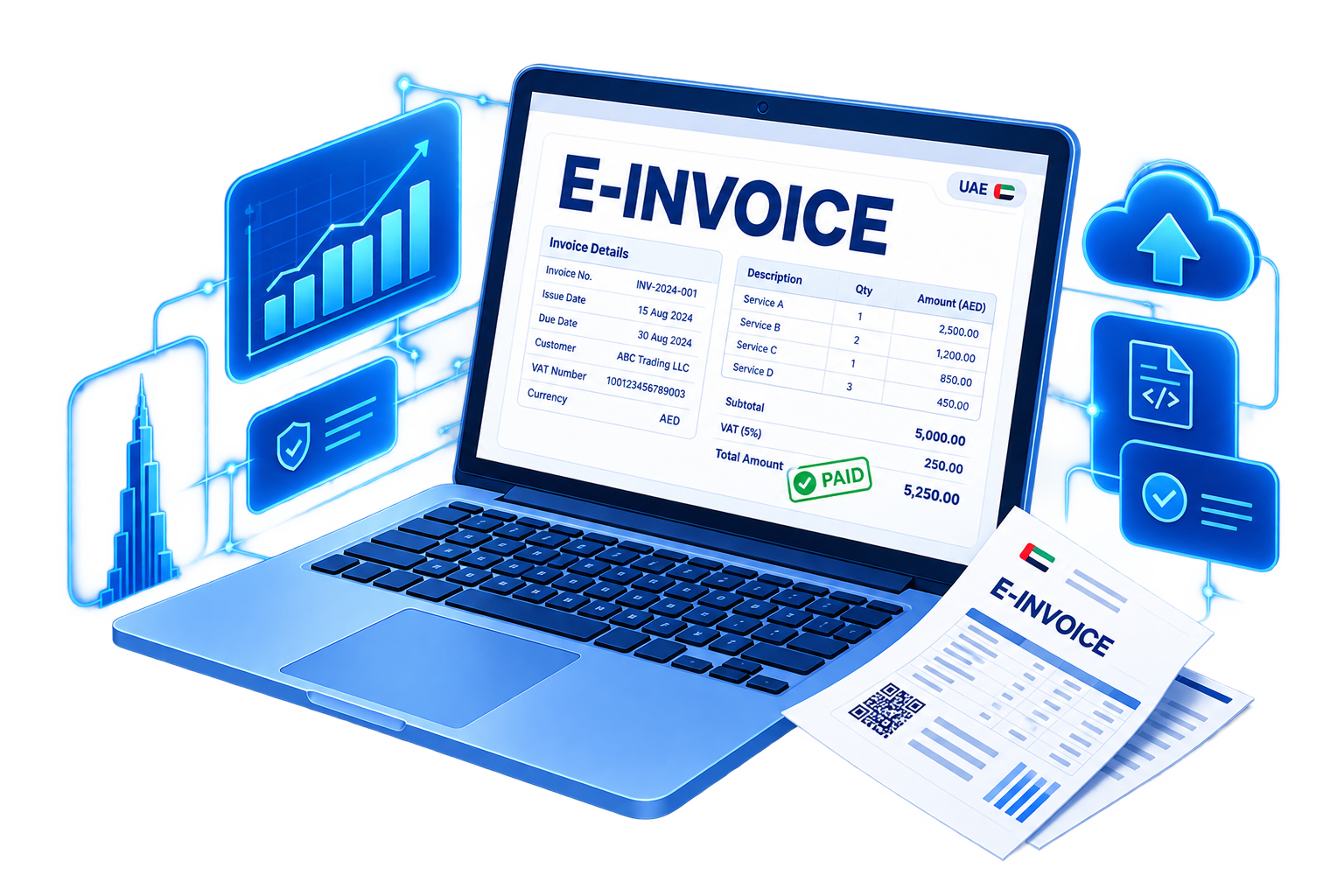
The introduction of E Invoicing for Construction Companies brings this information into a structured digital process. Invoice data will move electronically between the contractor and customer through the UAE system and be reported to the Federal Tax Authority. The change affects the information captured by project teams, the way finance prepares invoices and the systems used to exchange them.
SS & Co. Global helps construction businesses prepare their tax, accounting and invoicing processes for the transition. We review current documents, approval routes and software to determine how each billable event should reach the electronic invoice without losing the commercial detail behind it.
What Is E-Invoicing for Construction Companies?
An e-invoice is invoice data created, transmitted and received in a structured electronic format that allows automatic processing. It is exchanged through the UAE e-invoicing framework using an Accredited Service Provider. A PDF attached to an email, an image, a Word document or a scanned invoice does not meet this definition by itself.
For a contractor, the electronic invoice remains connected to a real supply of work, materials or professional services. The amount may come from a monthly valuation, a certified milestone, an approved variation or a contractual charge. The structured record must contain the prescribed fields while agreeing with the supporting documents used by the project and finance teams.
FTA Compliant Solutions
End-to-End Support
Seamless Integration
Secure & Reliable

Accounting records Construction E Invoicing involves aligning approved project information, contract values, VAT details and before the invoice is transmitted electronically. The business must decide where each required data field comes from, who confirms it and how the accounting or enterprise resource planning system will send and receive information through the appointed provider.
Contracts, bills of quantities, completion certificates, variation approvals and retention schedules still explain how the invoiced figure was reached. They also help resolve differences with the customer’s purchase order or payment certificate.
Why Is E-Invoicing Important for Construction Businesses?
Construction billing passes through several hands. Site engineers confirm progress, quantity surveyors value completed work, project managers approve changes and finance applies the tax treatment. Inconsistent information at any stage can delay billing and collection.
E Invoicing for Construction Firms creates a more consistent route for the final invoice data. Required details can be drawn from approved records and checked before transmission. This gives the recipient usable data and reduces the need to re-enter basic invoice information manually.
Clearer Links to Project Records
Project, contract, purchase-order and billing-period references help the customer match the invoice and trace it to the relevant job records.
Faster Processing of Approved Claims
Once a payment certificate or milestone is approved, finance can prepare the invoice from confirmed information. Agreed references reduce queries after the commercial value has been accepted.
Better Control Over Adjustments
Stronger Tax Records
Structured data strengthens the connection between sales records, output tax, customer balances and VAT returns, helping finance identify missing or duplicated transactions earlier.
Consistent Processes Across Projects
Companies operating several sites can establish the same minimum data, review steps and document references across projects while following each contract’s terms.
Our Services
Comprehensive E-Invoicing Services in UAE
Over 55 countries have already adopted such systems. The UAE is simply catching up to global best practice.
How Does E-Invoicing Work for Construction Companies?
The process starts within the construction business. A billable event is confirmed under the contract, and the approved amount enters the accounting or billing system. The system prepares the invoice data in the required structure and sends it through the company’s Accredited Service Provider.
The provider validates and exchanges the information through the UAE framework. The customer receives the structured invoice through its own provider, and the required data is reported to the FTA. Both issuer and recipient process electronic invoices and credit notes through the system.
- For E Invoicing for Contracting Companies, the internal steps commonly include:
- The project team confirms the completed work, milestone or charge.
- The quantity surveyor or authorised employee agrees the valuation and supporting references.
- Finance reviews the customer information, tax treatment, invoice date, retention and adjustments.
- The accounting system creates the required structured invoice data.
- The Accredited Service Provider validates and transmits the record.
- The status and any rejection message are returned to the responsible team for follow-up.
The exchange does not replace contractual certification. Where an engineer or consultant must approve a payment application, that workflow needs to remain aligned with invoice issuance. Premature transmission can create an invoice for an amount still under review.
E Invoicing Solutions for Construction Companies should take data from the approved stage, retain the connection with the claim and return transmission results to the responsible employees.
Our Simple 5-Step E-Invoicing Process
UAE E-Invoicing Requirements for Construction Businesses
The UAE system applies to persons conducting business in the country, subject to the stated exclusions. Business-to-consumer transactions currently remain outside mandatory implementation until a later decision. Transactions among contractors, subcontractors, developers and commercial customers should be assessed as business transactions.
- The present phased timetable is based on revenue:
- A person with revenue of at least AED 50 million must appoint an Accredited Service Provider by 30 October 2026 and implement the system by 1 January 2027.
- A person with revenue below AED 50 million must appoint a provider by 31 March 2027 and implement the system by 1 July 2027.
- Government entities must appoint a provider by 31 March 2027 and implement the system by 1 October 2027.
Revenue is determined for the most recent accounting period using financial statements or other acceptable records where statements are unavailable. Groups should assess each legal entity under the applicable rules.
The electronic invoices and credit notes shall be submitted promptly and contain all mandatory information. The associated data must be kept locally for prescribed retention period in the UAE.
A system failure must be reported to the Authority within two business days through the specified mechanism. A fallback procedure should assign responsibility for monitoring, reporting and pending documents.
An E Invoicing for Construction Companies UAE readiness review must include examining all relevant factors such as the legal entity, revenue threshold, types of transactions, current software in use, master data, and the process of approving documents. Early preparation offers companies opportunities to fix any incomplete records of customers and perform necessary integrations prior to the enforced implementation.
Industries Specific E-Invoicing Solutions
E-Invoicing Solutions for Every Industry
Your Trusted Advisor for Long-Term Success.
Who Needs E-Invoicing in the Construction Sector?
The requirements can affect general builders, civil engineering businesses, infrastructure contractors, fit-out specialists, MEP contractors and specialist trades. Project management, engineering and design firms should also review their transactions and deadlines.
E Invoicing for Contractors is relevant where the business issues invoices to developers, government customers, main contractors or other commercial entities. A business that acts as a recipient must also be able to receive and process structured invoices from suppliers and subcontractors.
The review should include free-zone entities, branches invoicing through a head office and businesses working across several emirates. The legal person, transaction type and implementation phase determine the position.
Businesses searching for E Invoicing for Construction Companies Dubai may need one plan covering sites across the UAE while preserving project-level approval and reporting.
E-Invoicing for Construction Firms and Contractors
The quality of an electronic invoice depends on the information available before finance creates it. Construction firms should map every common billing route.
Progress invoices need the correct period, project reference, approved value and tax details. Milestone invoices should connect with the evidence that the contractual event occurred. Time-and-material billing requires accurate labour, equipment and material records. Variations should be invoiced only after the required commercial approval has been obtained under the contract.
When retention is released, the project and finance records should show which earlier work and customer balance the release relates to.
For E Invoicing for Construction Firms UAE, legal names, tax registration numbers, addresses and customer identifiers should agree across contracts, accounts and the e-invoicing setup. Supplier data also needs review because the company will receive structured invoices.
A specialist can document these scenarios and test their system treatment, creating a repeatable path from approval to invoice with accessible commercial evidence.
100% FTA Compliant
End-to-End Solutions
Industry Experts
Secure & Reliable
Timely Support
Ready to Get E-Invoicing Compliant in UAE?
E-Invoicing for Contracting Companies in UAE
Contracting businesses often use separate tools for estimating, project management, procurement and accounting. The implementation should identify which system owns each required field and how approved data reaches the invoice.
Under E Invoicing for Contracting Companies UAE, consistent customer and project codes help route invoices where a customer operates several developments or issues several purchase orders. The company should review VAT classifications because e-invoicing transmits the selected treatment without deciding whether it is correct. Finance should resolve classification questions before they become repeated system entries.
SS & Co. Global provides an advisory service covering transaction mapping, VAT review, data-field assessment, invoice controls and testing support. We also help businesses examine whether their accounting records can produce the information required by the chosen solution.
When comparing a provider, contractors should consider integration, security, transaction volumes and compatibility with existing software. The best choice meets the legal and technical requirements while fitting the billing process. A top market position alone does not confirm that fit.
Businesses considering E Invoicing for Contracting Companies Dubai should define requirements before approaching providers so technical proposals can be compared on the same scope.
E-Invoicing for Main Contractors and Subcontractors
A subcontractor bills the main contractor, while the main contractor bills the developer under a separate agreement. Values and timing may differ because each contract has its own measurement, certification and retention terms.
The primary contractor must compare the invoices from the subcontractors against the service agreement and mandatorily check them with the order of sale, site confirmation and the payment approval. A defined route for disputed quantities tells accounts whether to hold, reject or request correction.
For subcontractors, E Invoicing for Construction Firms Dubai requires coordination between the site and office. The claim makers must have the required legal and fiscal data for the necessary approval, while the finance department must be informed on the evaluation and project reference which is to be provided by the principal contractor.
UAE rules allow self-billing where the relevant conditions are met. Existing agreements and responsibilities should be checked before configuring this process.
Whether the business needs E Invoicing for Construction Firms, main-contractor integration or subcontractor readiness, the workflow should give both parties a consistent record of what was supplied, what was approved and how the final amount was treated.
SS & Co. Global supports construction businesses with the accounting and tax work behind implementation. We review transaction types, legal entities, invoice fields, VAT treatments and the route from project approval to billing. This shows whether the existing process can produce complete and consistent data.
The review also considers credit notes, retention releases, advance recovery and the invoices received from subcontractors. Where information sits across several applications or spreadsheets, we identify its source and the employee responsible for approving it. The findings can then guide system configuration and provider discussions.
For businesses planning E Invoicing for Construction Companies, this work creates a practical readiness plan based on actual contracts and project records. SS & Co. Global is able to help with verifying the data, preparing the documentation, testing transactions and coaching the employees prior to the effective date. After the implementation it is necessary to carry on the periodic reviews, so as to make sure that the digital records are in line with the general ledger, client balances and VAT submission process. Contact Now.
Frequently Asked Questions?
Related Insights

UAE e-Invoicing Timeline Updated: ASP Appointment Extended, 2027 Rollout Remains
The e-invoicing UAE timeline has been modified, but the important 2027 deadline is still in place. On 10th May…

UAE Launches E-Invoicing Pilot Phase: What Businesses Need to Know
The UAE has officially entered a new phase of digital tax compliance with the launch of its e-invoicing pilot…

Which is the best e invoicing software in UAE?
The UAE government, since past decade, is making efforts to build a structured system for running businesses. That is…