

E Invoicing in UAE | Compliance & Service Provider Dubai, UAE
United Arab Emirates info@sscoglobal.com

E Invoicing

Let’s explore what this transformation holds for your business.

E Invoicing in UAE

The United Arab Emirates is preparing for a move towards the mandatory e-invoice framework, and those running their businesses here must be well prepared. Over 85% of companies in the region still rely on manual or semi-digital invoice processing, a reality that creates inefficiencies and compliance risks. The Federal Tax Authority has signalled that a nationwide e-invoicing system will soon become the norm, following global trends where countries like Italy and France have already cut VAT gaps by nearly 30%. The best e-invoicing provider in Dubai will be the one that comprehend local regulations and integrates seamlessly into your existing workflows. We, at SSCO Global are there to help you understand new regulations and stay ahead.

Our Tailored Services
Happy Customers
0 +
Skilled Accountants
0 +
Global Offices
0 0
Tailored Solutions
0 +

Introduction

You might have heard the term “e-invoicing” more frequently, thrown around at industry events or in tax circulars. But here is what most consultants won’t tell you: simply digitising your invoices does not equal e-invoicing compliance UAE. The UAE’s planned system goes beyond PDF attachments or email trails. It demands structured, real-time data exchange with the tax authority. According to a 2024 survey by a regional advisory firm, nearly 60% of finance leaders in Dubai admitted they are not fully prepared for this change. That is where SSCO Global steps in. We are there to find trusted e-invoicing services provider for your business, we have already helped dozens of firms transition smoothly.

Objectives and key benefits of the e-invoicing system

Why is the UAE government pushing so hard for e-invoicing? Three clear objectives drive this initiative. First, closing the VAT compliance gap. Current estimates suggest the UAE loses nearly AED 1.5 billion annually due to invoice manipulation and data mismatches. Centralisation closes the loopholes that create those losses. Second is reducing administrative burden. Manual data entry costs companies an average of 12 hours per week in finance departments. Third, improving audit transparency. With real-time reporting, tax audits shrink from months to days.

What does your business gain? It lowers processing costs by up to 60%, according to McKinsey research on digital invoicing. Payment cycles become faster, as disputes over missing or incorrect invoices are eradicated. When you choose the best e-invoicing provider in UAE, you also get strategic advisory on leveraging invoice data for cash flow forecasting, which is perhaps a competitive edge.

E Invoicing In UAE

What is e-invoicing?

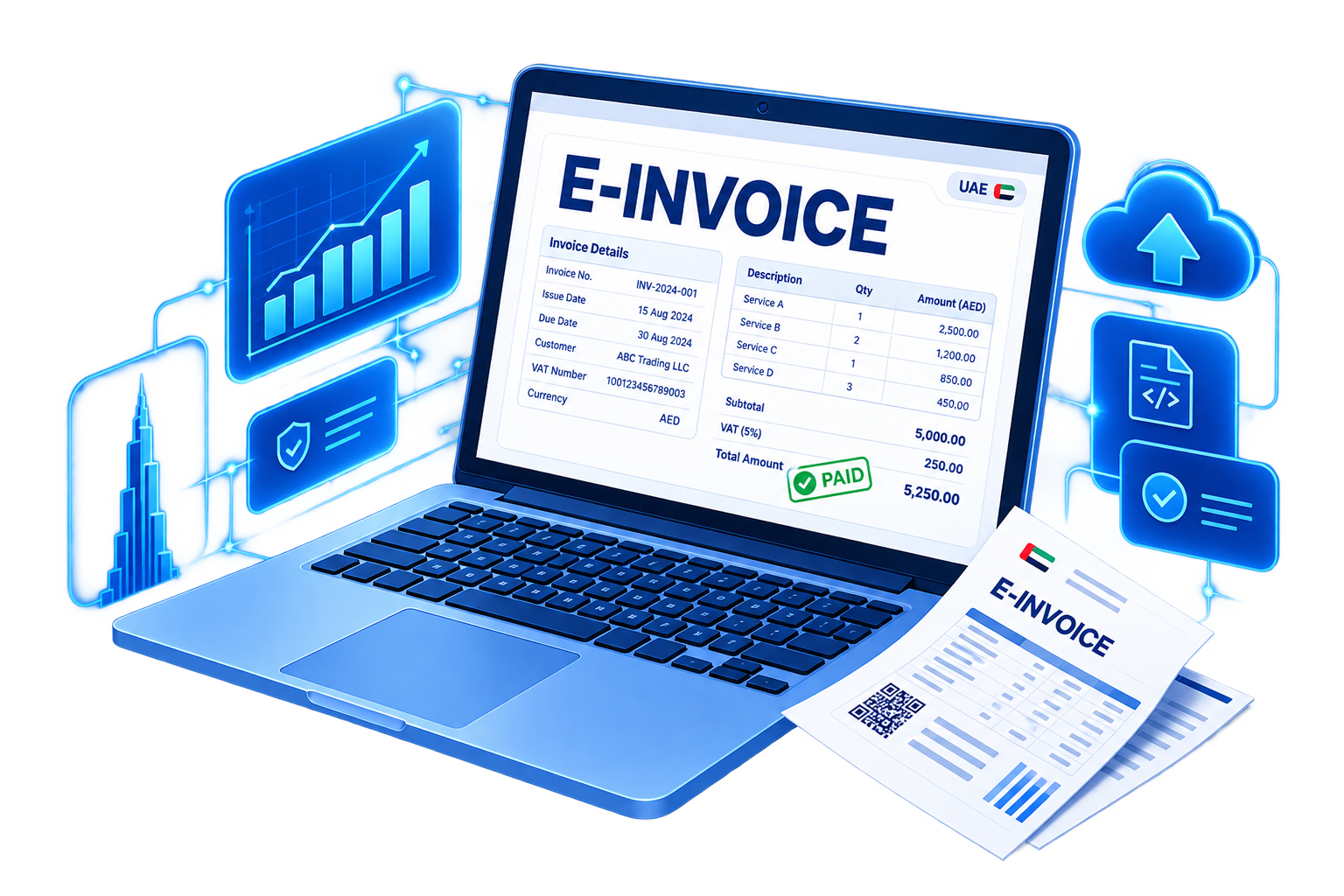
Many people still confuse E-invoicing as a PDF document. It is an end-to-end digital exchange of invoice data between a supplier and a buyer in a structured format, typically XML or UBL that can be read and processed automatically by accounting systems. The UAE model will likely follow a “continuous transaction control” approach, which means each invoice is validated by the tax authority in near real time before reaching the buyer. For example, when you raise an invoice, the system checks VAT, amounts, and tax rates against official registers. Only then does it issue a unique approval code. This eliminates fake invoices, duplicate submissions, and arithmetic errors. 

Over 55 countries have already adopted such systems. The UAE is simply catching up to global best practice.

How the UAE E-Invoicing System Works?

Understanding the mechanics helps you plan better. The proposed UAE e-invoicing system will operate on a five-step clearance model, similar to what Italy’s Sistema di Interscambio uses. Here is a breakdown of how data flows from your desk to the tax authority and back.

Step One
Invoice creation

Your accounting or ERP system generates an invoice in a government-mandated structured format. It is a machine-readable file containing line items, VAT rates, buyer and seller registration numbers, and a unique sequential ID. Many existing systems do not support this. That is why you need an e-invoicing solution that integrates with your current software.

Step Two
Real-time submission

Within 48 hours of issuing the invoice (likely sooner, based on draft regulations), you send the structured file to the Federal Tax Authority’s central platform. There is no manual uploading. The best e-invoicing provider will automate this step in the background.

Step Three
Validation and clearance

The FTA’s system runs automated checks. Does the buyer’s TRN number exist? Is the tax rate correct for the product category? The invoice total should equal the sum of line items according to the invoice. When all tests succeed the system generates an electronic verification code which it uses to record the invoice time. If something fails, you receive an error report within minutes.

Step Four
Delivery to buyer

The cleared invoice is routed to the buyer’s e-invoicing inbox or directly into their accounting system. The buyer can now claim input VAT credit immediately, because the tax authority has already verified the document’s authenticity.

Step Five
Archiving and audit

Both parties must retain the structured invoice plus the clearance code for 10 years. However, paper storage is no longer acceptable. The law expects digital archives with search and retrieval capabilities. A proper e-invoicing solution handle this automatically.

What about business-to-consumer transactions? Those may follow a simplified issuance model, but the same underlying principle applies: structured data, real-time reporting, and no room for manual shortcuts. According to a pilot study conducted by the FTA in 2023, companies using automated e-invoicing reduced invoice-to-payment time by an average of 11 days. That is real working capital freed up.

E Invoicing Compliance UAE

Which Taxpayers and Transactions Are Subject to E-Invoicing in the UAE?

Not every business will be in scope from day one. The FTA typically phases such mandates based on taxpayer size, sector, and VAT revenue contribution. Based on global precedents, here is what you can expect. Large enterprises, those with annual supplies exceeding AED 150 million will likely go first. Next come medium-sized firms (AED 10 million to AED 150 million). Finally, small businesses and startups get a longer runway. However, even if your company falls below the threshold, you might still need to comply if you transact with a larger business that demands e-invoices. Additionally, sectors with historically high VAT risks for instance, construction, wholesale trade, and professional services, will probably be prioritised. Delaying preparation only increases disruption. SS&Co Global offers a readiness assessment that maps your specific exposure based on the latest draft regulations.

Your Trusted Advisor for Long-Term Success.

E Invoicing Solution Dubai

What Transactions Are Covered?

The scope is deliberately wide. Standard B2B invoices are the obvious in it. But the system will also cover debit notes, credit notes, and advance payment requests. Even customs-related invoices for cross-border trade within the GCC may fall under the framework. Exempt supplies still need e-invoicing for tracking purposes, though no VAT is charged. The system will include special fields to identify reverse charge transactions which the system will track. For smaller invoices under AED 10,000, the rules will likely allow a lighter format, but the data still needs to be structured. Self-billing arrangements, where the buyer issues the invoice for the supplier require extra safeguards. The best e-invoicing solution must accommodate these particular business needs without requiring your team to master difficult alternative methods.

Preparing for E-Invoicing in the UAE: Key VAT Law Amendments ​
Since, the regulations are changing, you also need to track three specific amendments to the Federal Decree-Law No. 8 of 2017 on Value Added Tax. These changes redefine taxpayer obligations and penalties for non-compliance.

Beyond these amendments, watch for secondary legislation on interoperability standards. The FTA has hinted at adopting the PEPPOL framework, which is already used across Europe for cross-border e-invoicing. That would make it easier for UAE firms to trade with European partners. However, local flavours will exist. The best e-invoicing provider will stay on top of these technical specifications, so you do not have to. SS & Co Global maintains a dedicated regulatory advisory team that updates our solution within days of any FTA announcement.

How to Prepare for UAE E-Invoicing

First, it’s important to discover whether your current ERP or accounting software output structured formats like XML or UBL? If not, you need either an upgrade or an integration middleware. Second, map your counterparties. Identify which buyers and suppliers will also be subject to the mandate. Talk to your suppliers and customers early so everyone agrees on how invoices will be exchanged. Next, run a small test. The FTA provides a secure testing space which allows you to test your electronic invoicing system using fake data. The sandbox allows you to observe error frequency and processing duration. Then, train your people. Your accounts payable and receivable teams need to get comfortable with the new steps, especially what to do when an invoice gets rejected and how to send it back correctly. A study by McKinsey found that companies investing in change management before a digital mandate saw 40% fewer disruptions in the first quarter after go-live. Contact NOW.

E Invoicing Services

Your Trusted Advisor for Long-Term Success.

Frequently Asked Questions?

The FTA has not issued a fixed date yet, but industry sources expect a phased rollout starting Q1 2026 for large businesses. Medium firms would follow in 2027.

If you transact with any VAT-registered entity above the threshold, yes. Otherwise, you have more time but should still plan ahead.

All VAT-registered businesses will likely be required to adopt e-invoicing once it becomes mandatory. This includes small, medium, and large companies operating in the UAE under VAT laws.

Delayed submission triggers penalties starting at 5% of the VAT amount. Repeated offences can lead to temporary suspension of your tax registration.

Simplified e-invoices for consumers may use a less strict process, but the data must still be reported to the FTA within the same 48-hour window.

Freelancers registered for VAT will likely need to comply. Those not registered may not be required, depending on future regulations.

We partner with certified solution architects and maintain direct integration channels with the FTA’s sandbox. Our clients receive full technical support.

You risk losing input VAT deductions on purchases, damaging supplier relationships, and failing tax audits. That often costs more than fines alone.

Related Insights

Which is the best e-invoicing software in UAE?

Which is the best e-invoicing software in UAE?

The UAE government, since past decade, is making efforts to build a structured system for running businesses. That is…

What Is the Timeline for e-Invoicing in UAE?

What Is the Timeline for e-Invoicing in UAE?

How many invoices does your business send in a month, and how many of them disappear into follow-ups, delays,…

Key Aspects of UAE E-Invoicing (E-Invoicing System 2026–2027)

Key Aspects of UAE E-Invoicing (E-Invoicing System 2026–2027)

Have you ever wondered why the UAE is spending so much effort changing something as ordinary as an invoice?…

List of ASP for e Invoicing in UAE

List of ASP for e Invoicing in UAE

Are your invoicing systems ready for the next big shift in the UAE? For many companies, this is the…
UAE e-Invoicing Updates

UAE e-Invoicing Updates

Are you prepared for how invoicing is about to evolve in the UAE? July is approaching fast, and with…

E-invoicing in UAE: How to prepare for July 2026

E-invoicing in UAE: How to prepare for July 2026

July 2026 is way closer than it looks, and deadline for e-invoicing in UAE is approaching. Businesses are undergoing…

Who needs to do e-invoicing?

Who needs to do e-invoicing?

The e-invoicing system UAE marks a major shift in how businesses operate in the United Arab Emirates. From 2026…

What does LLC mean in Dubai?

What does LLC mean in Dubai?

A limited liability company, often called an LLC company in Dubai, is a distinct legal entity that separates business…

What are the changes in the UAE in 2026?

What are the changes in the UAE in 2026?

Key changes in Dubai, UAE in 2026 include a nationwide ban on single-use plastics, new tiered taxes on sugary…

What is E Invoicing in UAE?

What is E Invoicing in UAE?

E invoicing in UAE is a mandatory, structured way to create, transmit and receive invoices so both machines and…

What are the mandatory fields for e-invoicing in UAE?

What are the mandatory fields for e-invoicing in UAE?

The UAE has introduced a structured e invoicing system to standardize how invoices are created, exchanged, processed and reported.…

E Invoicing in UAE

E Invoicing in UAE

E-invoicing is changing finance operations across the UAE. The Ministry of Finance has scheduled a federal e-billing rollout for…

Subscribe to keep up with the latest industry insights
Register now for communications tailored to your interests.
Fill Out The Form
Get Free Consultation
Fill Out The Form Get Free Consultation

Subscribe for Data-Driven Insights and Trends

Subscribe for Data-Driven Insights and Trends

Get A Free Consultation

Get A Free Consultation

Fill Out The Form
Get Free Consultation
Fill Out The Form Get Free Consultation