
UAE E-Invoicing for Importers & Exporters
Let’s explore what this transformation holds for your business.
Home » UAE E-Invoicing for Importers & Exporters
E Invoicing for Importers and Exporters in UAE
An import or export invoice carries information beyond the amount payable. It identifies the parties, goods, currency, delivery terms and tax treatment, while related shipping and customs records show how the goods entered or left the country. When these details differ, the issue can affect clearance, accounting, payment and VAT reporting.
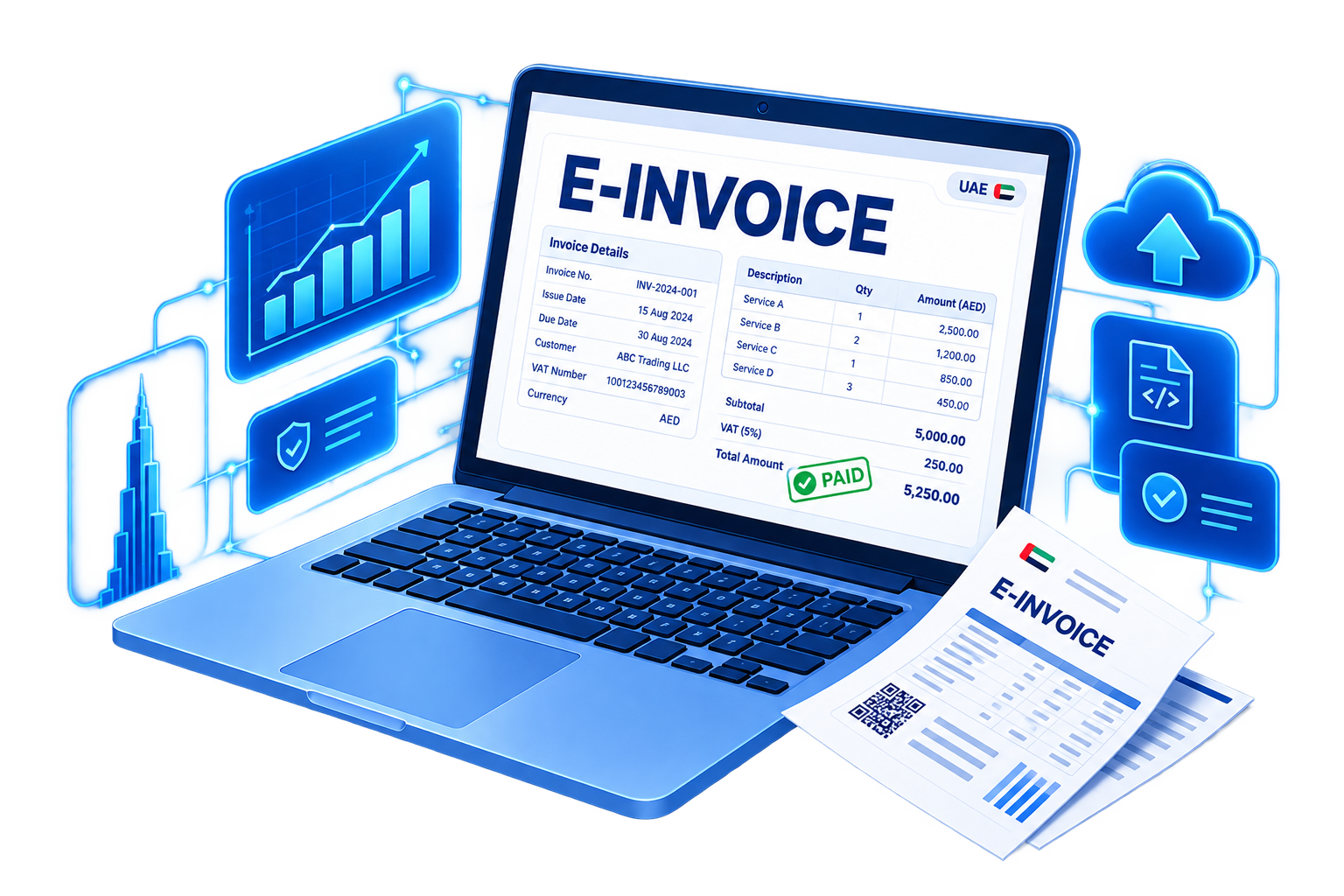
E Invoicing for Importers and Exporters brings the invoice data into a structured electronic process. Businesses covered by the UAE system will exchange electronic invoices and credit notes through an Accredited Service Provider, with the required information reported to the Federal Tax Authority. Importers and exporters should prepare their systems without losing the link between the invoice and the documents supporting the physical movement of goods. SS & Co. Global reviews sales, purchases, customs data, VAT treatment and accounting workflows to determine how an approved trade transaction should reach the system.
What Is E-Invoicing for Import and Export Businesses?
An e-invoice is issued, transmitted and received in a structured electronic format that allows automatic processing. A PDF, spreadsheet, scanned document or invoice attached to an email is not an e-invoice by itself. These formats may still be used for viewing or supporting a transaction, while the prescribed invoice data must pass through the approved electronic framework.
FTA Compliant Solutions
End-to-End Support
Seamless Integration
Secure & Reliable

For an Importer, the process may begin with a foreign supplier’s invoice and continue through freight, customs clearance and receipt. For Exporters, the sales invoice should agree with the order, shipment and transport documents.
Import Export E Invoicing focuses on the invoice and credit-note information exchanged between the relevant parties. It does not replace the bill of lading, airway bill, certificate of origin, customs declaration or packing list. Each record has its own purpose, and the business must keep them connected through consistent references and transaction data. The first task is to identify the transactions within the UAE requirements. A trading company may buy overseas, sell locally, re-export goods or supply foreign customers. Each route should be mapped before configuration.
How Does E-Invoicing Work for Importers and Exporters?
The process begins in the business system where an invoice is prepared. Once the transaction and tax treatment have been approved, the system creates the required structured data and sends it through the appointed Accredited Service Provider. The provider validates and exchanges the data through the UAE framework. The recipient processes the electronic invoice through its own provider, and the required information is reported to the FTA.
- For E Invoicing for Import Export Companies, a typical sales process may involve the following stages:
- The customer, product, quantity, price, currency and delivery terms are confirmed.
- The responsible employee checks the destination, supply date and VAT treatment.
- The accounting or enterprise system creates the invoice from the approved order or shipment.
- The provider validates and transmits the structured invoice data.
- The status is returned to the business, and any rejection is assigned for correction.
The purchase side needs a process for receiving, checking and posting structured invoices. Information regarding suppliers should comply with orders placed and receiving records. Also, local expenses incurred in logistics should reach the respective account accordingly.
For foreign currency, the system should preserve the original amount, applicable exchange-rate information and AED tax values required for the transaction.
Electronic credit notes follow the structured route when a transaction is cancelled, reduced or corrected. Returns and shortages should be supported by receiving records and an agreed settlement linked to the original invoice.
Our Services
Comprehensive E-Invoicing Services in UAE
Over 55 countries have already adopted such systems. The UAE is simply catching up to global best practice.
Why Is E-Invoicing Important for Trading Companies?
Trading businesses process many product lines across different parties, currencies and destinations. E Invoicing for Trading Companies creates a consistent format for exchanging the final invoice information.
More Reliable Transaction Matching
Clearer Links with Customs Records
Better Control Over Adjustments
Stronger VAT Reconciliations
Faster Internal Review
UAE E-Invoicing Requirements for Importers and Exporters
The rules apply to persons conducting business in the UAE, subject to specified exclusions. Trading businesses should assess their responsibilities as both issuers and recipients.
The phased implementation dates are based on revenue. A person with revenue of at least AED 50 million must appoint an Accredited Service Provider by 30 October 2026 and implement the system by 1 January 2027.
A person with revenue below AED 50 million must appoint a provider by 31 March 2027 and implement by 1 July 2027. Government entities must appoint a provider by 31 March 2027 and implement by 1 October 2027.
Business-to-consumer transactions remain outside mandatory implementation until a later decision. Import and export firms should assess domestic, cross-border and related-party dealings using the identity of each party and the nature of the supply. Electronic invoices and credit notes must contain the prescribed fields and be transmitted within the applicable timeline. Their data must be stored within the UAE for the required period.
System failures must be reported to the Authority within two business days through the prescribed mechanism. A written procedure should cover failed transmissions, escalation and pending records after the Service resumes.
For Import Export E Invoicing UAE, readiness should include legal-entity scoping, revenue assessment, provider appointment, master-data review and transaction testing. The business should also identify any manual spreadsheets or separate trade applications that supply information to the accounting system.
Our Simple 5-Step E-Invoicing Process
Who Needs E-Invoicing in the Import and Export Sector?
The requirements may affect traders, distributors, wholesalers, industrial suppliers, free-zone entities, export houses, manufacturers selling abroad and businesses arranging re-exports.
E Invoicing for Importer operations also covers domestic invoices connected with clearing, transporting, handling and storing imported goods.
An importer may receive invoices from UAE freight forwarders, customs brokers, ports, warehouses, transporters and inspection providers. These domestic business transactions may enter the electronic system separately and need to be allocated to the correct shipment or landed-cost calculation.
E Invoicing for Exporters applies to the invoicing processes used for customers and other business recipients. The exporter should assess the parties involved, where the customer is established, the destination of the goods and the records supporting the chosen VAT treatment.
Trading groups should assess each legal person. User access, invoice sequences, tax registration numbers and provider onboarding must reflect the entity carrying out the transaction.
Industries Specific E-Invoicing Solutions
E-Invoicing Solutions for Every Industry
Your Trusted Advisor for Long-Term Success.
E-Invoicing for Importers in the UAE
Import accounting combines the supplier’s price with freight, insurance, duty, import VAT and local handling. These amounts may be recorded separately and allocated to inventory. The foreign invoice, customs declaration and local service invoices are separate records. They support the purchase, import entry and UAE logistics charges respectively.
Shipment, purchase-order or consignment references help finance compare ordered, shipped, declared and received quantities. Under E Invoicing for Import Export Companies UAE, the business should review supplier master data, product codes, units of measure, currency fields and tax codes.
It should also decide how employees will handle partial shipments, back orders, damaged stock, purchase returns and post-import price adjustments.
The provider should connect with the systems holding this information. The best arrangement preserves detail without duplicate entry. A top solution still requires testing against the actual receiving process. Businesses considering Import Export E Invoicing Dubai should include transactions cleared through other emirates in their review. The customs location may vary, while the legal entity and accounting system remain the same.
E-Invoicing for Exporters in the UAE
An export transaction connects the order, invoice, dispatch and evidence of movement. The e-invoice carries structured data, while the shipping file records what happened to the goods.
For Exporters, zero-rating under UAE VAT depends on the relevant legal conditions and evidence. The invoicing system will transmit the treatment selected by the business; it will not decide whether the conditions have been met. Finance should confirm the position using the contract, destination, transport arrangements and available export records. The customer’s legal name, country and identifiers should be complete. Product descriptions, quantities, currency, delivery terms and requested references should agree with the order and shipping documents.
E Invoicing for Trading Companies UAE also requires a procedure for changes after shipment. A shortage, quality claim, rebate or agreed price reduction may require an electronic credit note. The adjustment should identify the earlier invoice and agree with the commercial settlement approved by both parties. For businesses seeking E Invoicing for Trading Companies Dubai, preparation should include sales teams as well as finance. Sales employees often create customer records and agree delivery terms, so their data directly affects the invoice later sent through the system.
E-Invoicing for Import and Export Companies
A trading company should map overseas and local purchases, domestic sales, exports, re-exports, related-party supplies and returns.
Each data field needs an identified source and owner. Customer details may sit in accounting software, product information in inventory and shipment references in a logistics platform.
SS & Co. Global reviews these flows as part of its E Invoicing for Import Export Companies Dubai support. We assess invoice and credit-note formats, VAT classifications, customs reconciliations, master data and accounting entries. The review emphasizes missing, duplicated, or inconsistently maintained fields.
Testing for E-Invoicing for Trading Companies must use real business cases instead of just a single example of an invoice. The test set should include multiple currencies, partial shipments, local charges, export sales, returns, credit notes and rejected transmissions. Users should confirm that each result reaches the correct ledger, customer or supplier account.
Selecting Solutions also requires a clear scope. The business should consider transaction volumes, software integration, security, data storage, response times and support for users in the UAE. The appointed provider must be accredited for the UAE framework.
SS & Co. Global can help the business prepare requirements, coordinate accounting and tax testing and document responsibilities. The aim is to give the Importer, finance team and sales employees a workable process that continues to agree with customs data and VAT reporting after implementation.
The implementation file should record the decisions made during this work. It can include the transaction map, field ownership, approved tax codes, provider responsibilities, test results and the procedure for rejected invoices. This gives employees a reference when an unusual shipment or adjustment arises after launch.
Periodic checks are also useful once live transactions begin. A sample of electronic invoices can be traced to orders, shipping records, customs entries and ledger postings. Incoming invoices can be checked against supplier accounts and landed-cost calculations. These reviews show whether the system is operating as designed and whether a change in products, trade routes or software has created a new data gap. Contact NOW.
100% FTA Compliant
End-to-End Solutions
Industry Experts
Secure & Reliable
Timely Support
Ready to Get E-Invoicing Compliant in UAE?
Frequently Asked Questions?
Related Insights

UAE e-Invoicing Timeline Updated: ASP Appointment Extended, 2027 Rollout Remains
The e-invoicing UAE timeline has been modified, but the important 2027 deadline is still in place. On 10th May…

UAE Launches E-Invoicing Pilot Phase: What Businesses Need to Know
The UAE has officially entered a new phase of digital tax compliance with the launch of its e-invoicing pilot…
Which is the best e invoicing software in UAE?
The UAE government, since past decade, is making efforts to build a structured system for running businesses. That is…